North-facing roofs are still the default recommendation for rooftop solar in Australia — yet plenty of households with “perfect” north aspects report softer savings than expected. Orientation is only one variable in a yield-and-value equation that also includes tilt, shade, inverter behaviour, and when you actually use electricity.
North maximises annual kilowatt-hours, not always bill savings
A north-facing plane often delivers the highest annual generation for a given array size. That does not automatically mean the highest dollar return. If your household imports heavily after 5pm and exports most midday surplus at a low feed-in rate, a west-leaning layout can cut more expensive evening imports even with fewer total kilowatt-hours.
Designers who only optimise for peak annual yield can miss that tariff mismatch. Ask for a self-consumption estimate, not just a generation graph.
Tilt and roof pitch quietly move the winter curve
Low-pitch north roofs common on modern builds can underperform in winter relative to steeper traditional roofs. Winter sun sits lower; a shallow tilt catches less of it. Households with electric heating or all-day occupancy in cooler months notice the gap first.
Neighbour shade does not care about compass direction
A north roof shaded by a two-storey neighbour, street tree, or dormer can behave worse than an unshaded east or west plane. String inverters amplify the problem: one shaded module can drag a whole string. Morning and afternoon shade that looks minor on a site photo may coincide with your best production hours.
- Request a shade assessment for solstice and equinox hours
- Compare north-only vs mixed-orientation layouts on the same quote
- Ask how the inverter or optimisers handle partial shade
Temperature and dark roofs reduce real-world output
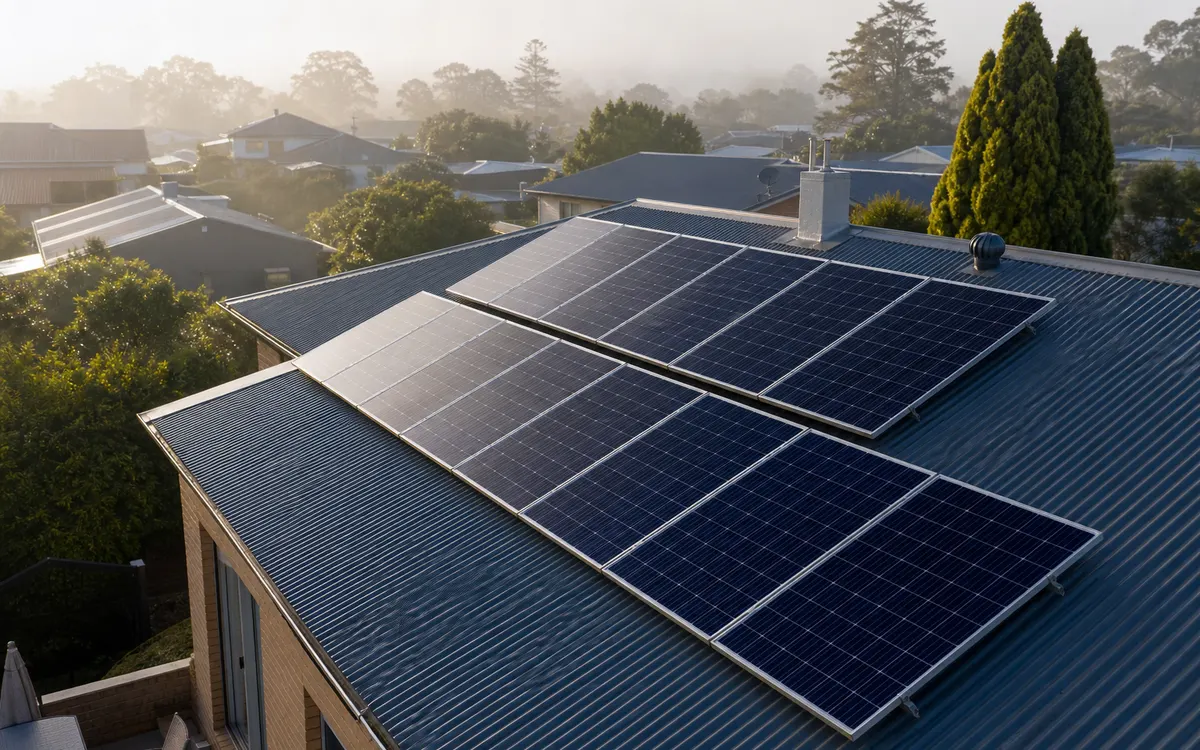
Panel nameplate ratings assume laboratory conditions. Hot Australian roofs — especially dark metal — raise cell temperature and trim efficiency precisely when summer irradiance is highest. North planes that bake all day can lose more to heat than a west plane that works harder later in cooler afternoon air.
A “perfect” north roof still loses to shade, heat, and evening tariffs if the design ignores how you live.
Inverter clipping on oversized north arrays
Some quotes pair a large north array with a smaller inverter to save cost. Midday clipping then discards the very surplus the north orientation was meant to create. That can be acceptable if you rarely need peak midday watts — but it should be a conscious choice, not an accidental underperformance.
When north still wins
Homes with strong daytime loads — heat pumps on timers, home offices, pool filtration, EV charging at midday — often do best with a robust north array. The underperformance stories usually come from empty-day, peak-evening households sold a north-only system without habit or tariff advice.
What to ask before you accept the default
Press for a side-by-side of north versus mixed orientation using your bill profile. Confirm export limits so oversized north capacity is not stranded. If trees will grow, bake that into the year-five yield, not only year one.