In Australia the “distributor” (DNSP) — not a UK-style DNO label — approves how your inverter connects and how much you may export. Timelines vary by network, application quality, and whether dynamic export or manual studies are required.
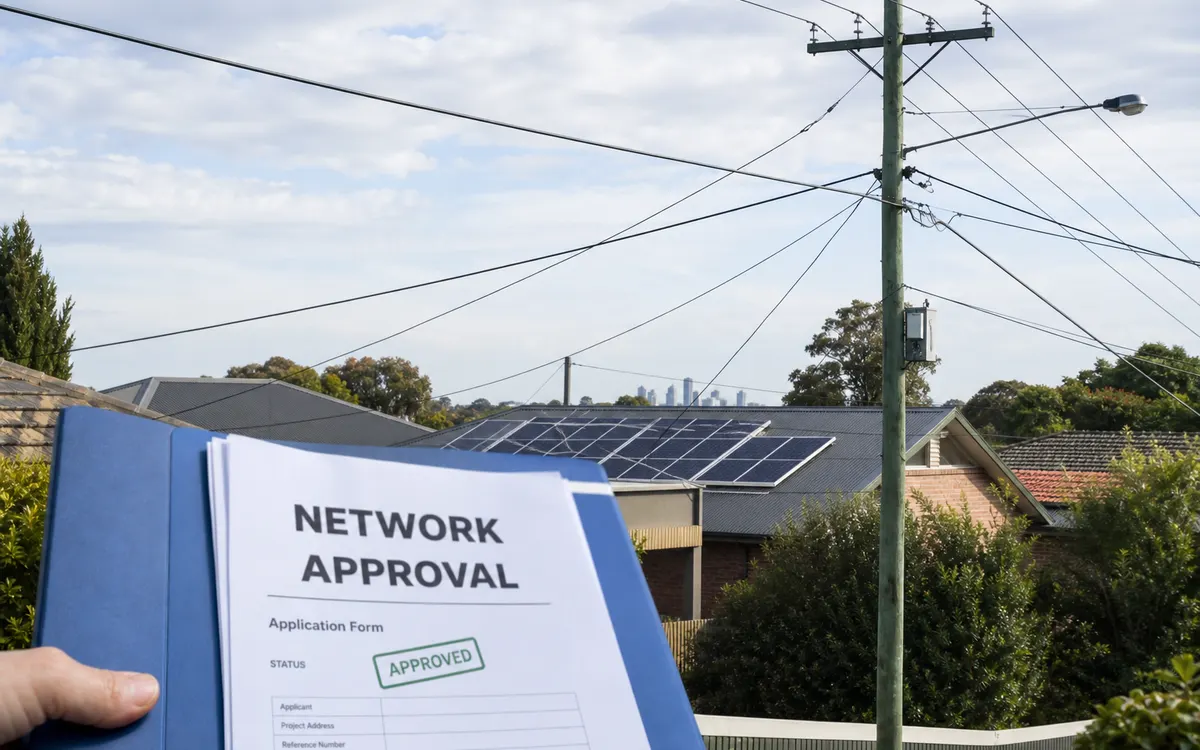
Why approvals exist
Networks manage voltage, protection, and fairness between neighbours. Your roof size does not override feeder physics.
| Application type | Typical experience | Owner tip |
|---|---|---|
| Small straightforward residential | Days to a few weeks when complete | Submit accurate inverter models |
| Larger systems / tight feeders | Longer; may need studies | Pre-check before paying large deposits |
| Dynamic export enabled | Depends on device compatibility | Confirm gateway and meter needs |
| Battery added later | Often a new or amended application | Do not assume silence means consent |
- Identify your DNSP from a bill or postcode lookup
- Ask the installer for the submitted export request
- Keep the approval letter for commissioning checks
- Build timeline slack into finance start dates
The approval letter is the system size that matters.
Incomplete applications stall everything
Wrong inverter models, missing site sketches, or unbalanced three-phase proposals bounce. Quality beats optimism.
If the limit is lower than hoped
Redesign for self-consumption, storage, or a smaller array. Arguing without a technical basis rarely lifts a feeder constraint.